
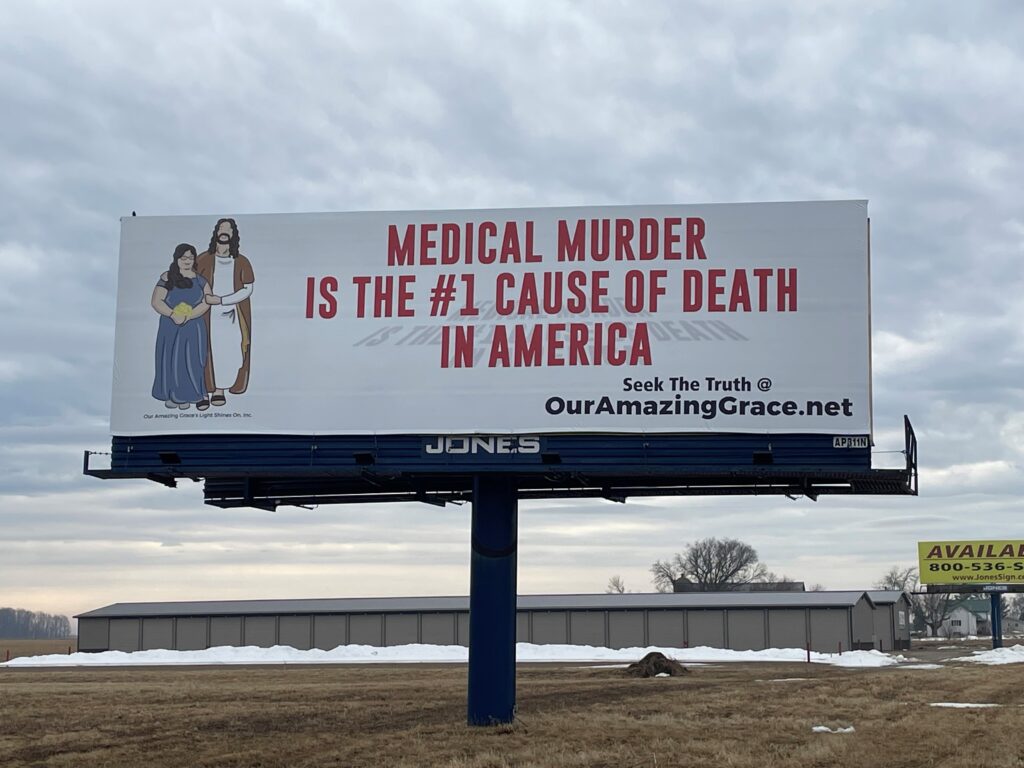
Institutional authority depends on public trust. People enter hospitals expecting doctors to act in their best interests, look to governments for physical protection, and turn to religious institutions for spiritual guidance. Yet Scott Schara (Grace’s Dad), President of Our Amazing Grace, believes this trust has created a dangerous vulnerability, one that leaves individuals increasingly reluctant to question the systems making decisions about their lives. His argument comes from an experience that permanently altered his own understanding of authority. In 2021, his daughter Grace died following a hospital treatment, prompting a personal investigation that eventually challenged almost everything he had previously accepted as truth.
“I didn’t realize how programmed I was until Grace’s death,” Schara recalls. “And then I started researching, first of all, why she died, but then the much bigger question: how did I get duped? The agenda. The programming. This is why Grace died.” He has since devoted himself to examining what he considers a culture of unquestioning obedience, arguing that people frequently mistake institutional authority for factual evidence.
One of the central ideas in his criticism is what he calls the “illusion of choice”. Schara argues that society presents people with supposedly opposing alternatives while keeping them within the same overarching systems. Political divisions between Democrats and Republicans are one example he frequently raises. He believes people become invested in choosing between the deception of competing positions without examining the assumptions governing those choices.
He connects this conditioning to the language of collective responsibility, recalling his own decision to have Grace tested for “COVID” before attending a wedding. At the time, he believed it was his civic duty to protect others. He now considers that decision an example of how the appeal of the “greater good” can override individual judgement. His understanding of freedom has consequently changed, particularly through drilling into his Christian faith.
Grace’s influence on his thinking is inseparable from the grief of losing her. Named after God’s grace, she was born with Down syndrome, something Schara initially struggled to understand in terms of what her future might hold. His assumptions quickly gave way to admiration as she became his closest companion, joining him on hunting and fishing trips. He remembers her faith as something he had much to learn from. Her innocence and instinct to question the world remain powerful reminders of what he believes members of society lose through systems designed to indoctrinate.
The family’s wrongful-death trial further intensified his criticism regarding the lack of institutional accountability. Schara says the family spent approximately $1.1 million in legal fees before losing the case by an 11-to-one jury decision. Schara said that they chose against an appeal, “Because we did what we were called to do. The trial was live-streamed and therefore showed what is normally kept out of the public view. The legal system protects the medical system.”
One argument presented during the proceedings became particularly significant to his subsequent advocacy. According to Schara, the defense maintained that entering a hospital constituted implied consent to treatment. “Once they saw that we were making some great arguments, the defense came up with an idea called implied consent,” he recalls. “And so they said, when you cross the threshold of a hospital, you are giving implied consent. You don’t have to give consent for any medical treatment.”
In Grace’s case, her death certificate states her “immediate cause” of death was “acute respiratory failure with hypoxemia, due to or as a result of COVID-19 pneumonia.” Her actual immediate cause of death was the combination of the contraindicated medications Precedex, Lorazepam, and Morphine, without knowledge or consent, facilitated by an illegal Do Not Resuscitate order placed on Grace’s chart unilaterally by a doctor.
To Schara, this raises fundamental questions about bodily autonomy. He urges patients to establish their expectations before receiving treatment, insisting that consent must remain an explicit personal decision. His experience has also shaped his concern about what he calls the institutional world “behind the curtain,” where he believes decisions affecting patients can escape meaningful scrutiny. The WHO estimates that more than 3 million deaths occur globally each year due to unsafe care, and around half of the harm associated with unsafe care is preventable, which further reinforces his case.
These arguments formed the basis of his published book, Is the Government Legally Killing Us?, alongside two works in progress, Is“The Church”Spiritually Killing Us? and Escaping Babylon. Drawing on his interpretation of Revelation 13, Schara examines government and organized religion through what he regards as two sides of the same coin ruling this world. His Christian worldview provides the foundation for his criticism, while his wider objective is to encourage readers to examine the beliefs guiding their decisions.
His proposed starting point is reclaiming our God-given birthright. An example of this is restoring our critical thinking. “Everything in our society is designed against critical thinking,” he argues. He encourages people to put down their phones, read more carefully, and investigate the origins of familiar claims before accepting them. According to Schara, intellectual freedom also requires overcoming the fear of standing apart from the crowd.
Schara’s story raises a question that remains difficult to dismiss. How much of what society accepts as the truth have we actually taken the time to question?
His motivation, however, remains deeply personal. “I don’t want anybody to lose their best buddy,” he says, reflecting on the loss that set his work in motion. He acknowledges that he is neither a doctor nor a lawyer. His credentials, as he puts it, are “DAD”. It is the voice of a father who believes his daughter’s story must serve a purpose, and who has made reproving this world’s systems his life’s work. God’s grace and Grace remain the reasons he refuses to stop.