
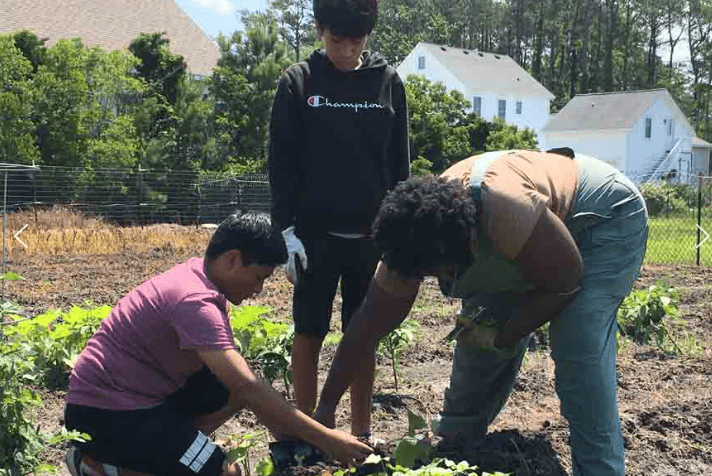
(Rev. Dr. Michelle Lewis, source: Rev. Dr. Michelle Lewis)
Access to food is often framed as a logistical challenge, measured through supply chains, distribution systems, and affordability. Rev. Dr. Michelle Lewis, Founder and Executive Director of the Peace Garden Project, approaches it differently. From her perspective, food insecurity reflects a wider set of social, environmental, and cultural conditions that shape how communities function and how individuals experience dignity within them.
That broader framing is reflected in the scale of the issue itself. According to a report, 13.7% of U.S. households experienced food insecurity in 2024, representing millions of families navigating inconsistent access to adequate nutrition.
Within this context, Lewis leads a nonprofit initiative that grows fresh produce for individuals and families experiencing food insecurity while also building community-centered programs that extend beyond food distribution. She explains that the work is rooted in the understanding that access alone does not fully address the lived realities of those navigating economic hardship.
Her perspective was shaped by personal experience. While attending graduate school, Lewis found herself struggling financially despite working multiple jobs. After being told she did not qualify for assistance due to a marginal income difference, she began to reflect on those without any safety net. “I started thinking about all the people who don’t have anyone they can call,” she says. “That moment became a turning point that ultimately led to the creation of the Peace Garden Project.”
The organization itself is structured around a simple but expansive model. Gardens are cultivated within communities, often with local institutions such as churches, and the food grown is distributed freely to those who need it. According to Lewis, the intention is not only to provide nourishment but also to remove barriers that often accompany traditional support systems. “We grow it so we can give it all away, an approach that prioritizes accessibility without conditions,” she says.
This approach aligns with broader discussions around food systems and public health. Recent research highlights that food insecurity is consistently linked to poor diet quality and higher risks of cardiometabolic disease, obesity, and mental health challenges across the life course. Lewis notes that, in her experience, improving access to fresh produce often creates ripple effects that extend into health outcomes and personal confidence.
What has emerged from this model extends beyond food. In one early garden, Lewis observed how shared workdays brought together individuals from different cultural and religious backgrounds, creating new relationships where there had previously been distance. She notes that these interactions revealed how community spaces, when designed with openness, can shift perceptions and build trust in ways that formal programs often struggle to achieve.
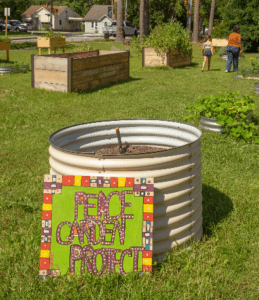
This broader lens also informs how Lewis views the intersection of food access with environmental and social justice. From her experience, communities most affected by limited access to fresh food are often navigating multiple challenges simultaneously, including economic constraints and environmental inequities. The Peace Garden Project incorporates these realities into its programming, including youth leadership initiatives that invite young people to analyze community issues and participate in decision-making around food distribution.
(Rev. Dr. Michelle Lewis, source: Rev. Dr. Michelle Lewis)
“Young people have a remarkable ability to consider different perspectives and approach challenges with openness and thoughtfulness,” Lewis says. “That kind of mindset creates space for more inclusive and compassionate ways of supporting communities.”
The organization’s work also extends into storytelling and representation. Through the Outer Banks Environmental Film Festival, the project highlights narratives that connect environmental conditions with lived human experiences. Lewis explains that representation in this space ensures that environmental conversations reflect the full spectrum of communities impacted, rather than presenting a limited or simplified view of environmental challenges.
At the same time, the Peace Garden Project continues to expand its scope. Plans for the coming years include establishing a permanent site that will support both food production and a retreat space for individuals engaged in environmental and community-based work. Additional initiatives include a podcast focused on environmental storytelling and the development of products.
Throughout these efforts, Lewis maintains that the central goal remains consistent. The work is designed to shift how society understands both need and response, encouraging a more human-centered perspective that acknowledges complexity rather than simplifying it.
“Not having enough to eat is not a moral failing,” Lewis says. “It is a reflection of systems and circumstances that many people are navigating, and it deserves to be met with understanding and support.”
Ultimately, the Peace Garden Project presents a framework that connects food, environment, and community as interdependent elements rather than separate challenges. Lewis’s work suggests that addressing one requires engaging with all, and that meaningful change often begins in spaces where people gather, grow, and share together.
“The seeds we plant matter,” Lewis says. “They matter in the ground, and they matter in how we choose to show up for one another.”
