
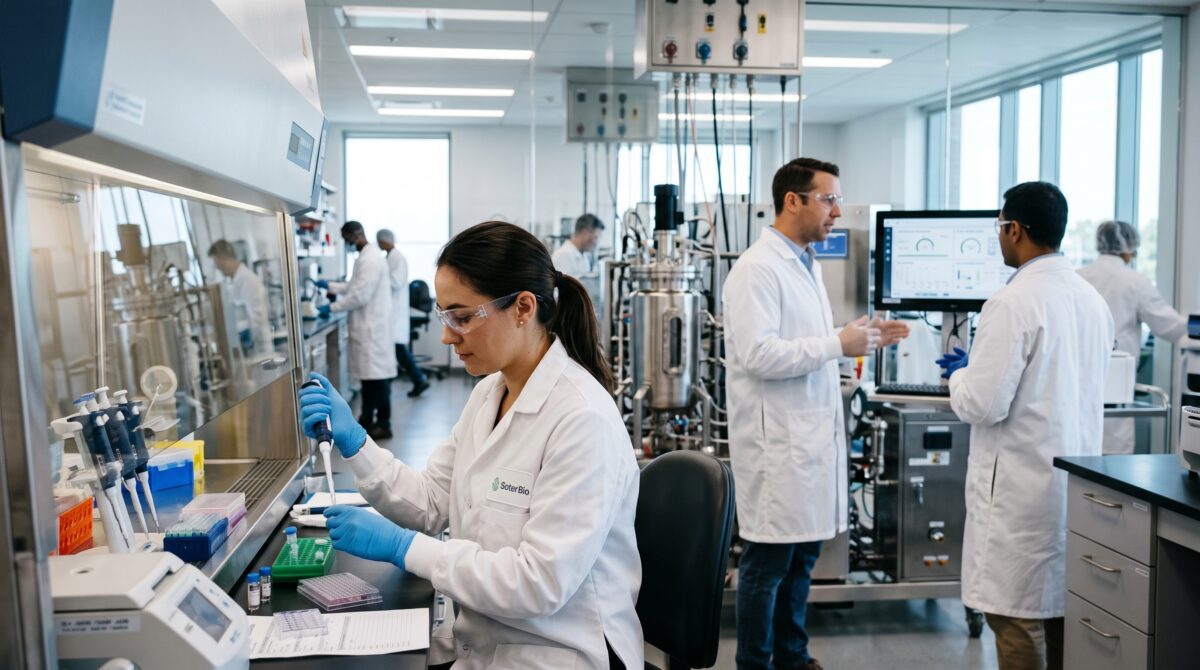
A scientific breakthrough can create the possibility of a promising new therapy, but delivering that treatment to patients may involve months of coordinated manufacturing, testing, and quality checks. For advanced therapies, factors such as production capacity, specialized equipment, raw-material availability, and manufacturing expenses can all affect how quickly a treatment reaches patients.
According to Alira Health’s 2026 Biologics Contract Manufacturing Report, the global biologics contract manufacturing market reached $23.2 billion in 2025, with growing investment in specialized manufacturing capabilities. These findings highlight why manufacturing expertise and infrastructure deserve attention early in the therapeutic development process.
For Mike Stewart, founder and CEO of Soter Bio, a U.S.-based contract development and manufacturing organization (CDMO) focused on advanced biologics, including mRNA, cell therapy, gene therapy, and plasmid DNA, manufacturing readiness is a vital component of therapeutic innovation. With 24 years of experience in biopharmaceutical development and operations, Stewart understands the connection between scientific advancement and practical delivery. “The most important lesson is to solve the whole problem,” he explains. His approach emphasizes the need to bring process development, quality assurance, supply-chain planning, and patient access together.
This approach is especially important in mRNA manufacturing, where product quality relies on several closely connected processes. Manufacturers must often manage RNA identity, integrity, purity, and biological activity while overseeing formulation, filling, storage, and transportation. Stewart points out that lipid nanoparticle formulations bring further quality requirements, including particle characteristics and encapsulation efficiency.
A 2026 review published in Molecular Biology Reports and indexed by Springer Nature explores the process controls and analytical techniques that help maintain product quality. These requirements demonstrate that manufacturing readiness relies on coordinated expertise throughout production and testing.
Personalized cancer vaccines introduce additional challenges because each patient may need a uniquely designed product and an individualized manufacturing schedule. Traditional timelines can include documentation, sourcing materials, production, testing, and product release. When these activities are managed by separate teams or external providers, scheduling and handovers can extend the overall process. Stewart explains, “The full manufacturing pathway deserves attention, since improvements within a single production step may have limited effects on the total time from patient-specific design to treatment.”
Soter Bio’s personalized vaccine manufacturing model is designed to substantially shorten end-to-end timelines compared with conventional methods. This distinction is important because the time required to process a sequence into a product is not the same as the full period between a patient’s biopsy and treatment administration. Stewart stresses that clearly defined timelines and documented outcomes are essential for developers seeking to measure the real-world benefits of manufacturing improvements.
Greater efficiency can come from better coordination as well as improved production technology. Closed manufacturing systems can minimize contamination risks during handling, while automation may enhance consistency and reduce manual intervention. In-line analytics can deliver timely insights into process conditions, allowing teams to identify potential deviations sooner.
Stewart’s operational experience also underscores the importance of preparing thoroughly before production begins. Documentation, quality agreements, raw-material sourcing, and sample-planning activities can account for a considerable share of the overall timeline. Having appropriate materials available and using reusable documentation frameworks may help eliminate unnecessary preparation delays.
“A target, a modeled estimate, and a demonstrated result are different things,” Stewart remarks. “Efficiency targets become more informative when supported by repeatable performance data and clearly defined endpoints.”
The potential applications extend beyond personalized cancer therapies. Flexible manufacturing platforms could also support animal-health vaccines and therapeutics, where production costs and batch sizes can affect development and supply. These capabilities may also strengthen pandemic preparedness by providing the development, testing, and production resources required when public-health needs evolve.
The World Health Organization’s mRNA technology transfer program offers an example of international efforts to expand manufacturing knowledge and establish regional production capabilities. Achieving these potential benefits, however, requires product-specific validation, suitable regulatory oversight, and infrastructure capable of meeting different manufacturing demands.
Investment is another essential part of the equation. “When people look at advanced therapy manufacturing, they often focus strictly on floor space, but that’s only part of the equation,” Stewart says. “True operational capacity depends on specialized testing, ready-to-go processes, proper materials, and expert talent. Setting all of that up takes substantial capital upfront, often months or years before a program starts generating revenue.”
At Soter Bio, which is developing U.S.-based manufacturing infrastructure for advanced biomolecules and active pharmaceutical ingredients, these factors contribute to the case for coordinated domestic production capabilities. Closed systems, automation, and scalable infrastructure may help strengthen supply resilience, while early investment in testing and quality operations can better align manufacturing capacity with batch-release requirements. Stewart believes investment decisions should begin by identifying the constraints most likely to affect a particular program, whether those involve equipment, testing capacity, documentation, or material availability.
Manufacturing improvements may also help make therapies more affordable by reducing duplicated work, using resources more efficiently, and preventing avoidable delays. However, patient access is influenced by more than manufacturing costs alone. Clinical evidence, regulatory approval, reimbursement, treatment delivery, and healthcare financing all play important roles. Lower production costs may create opportunities to expand access, but the extent of those benefits depends on decisions throughout the therapeutic development and healthcare systems.
For biotech executives and investors, manufacturing readiness may therefore deserve attention from the earliest stages of therapeutic development. Developers, CDMOs, analytical specialists, and regulatory teams can work together on process transfer, material sourcing, testing plans, and future production needs before these issues become urgent. Investors can help support this work by funding process development, validated analytical methods, manufacturing infrastructure, and skilled personnel alongside scientific research.
“Discovering new science gives patients hope, but reliable manufacturing is what makes that hope actionable,” Stewart remarks. “By viewing manufacturing readiness as a critical development milestone rather than an afterthought, and investing in repeatable quality, biotech leaders can improve their chances of getting life-changing therapies to patients within meaningful timeframes.”
