
Disability has always been part of the human experience, touching every region, generation, and community. Today, an estimated 1.3 billion people worldwide live with significant disabilities. Yet opportunities for independence, connection, and self‑expression often hinge not only on accessibility, but also on how others perceive their abilities.
Many people with disabilities continue to face barriers that shape their access to community life, personal autonomy, health, education, and employment. These barriers extend beyond physical or digital accessibility; they influence how individuals participate in their communities and pursue the futures they imagine. Public perception remains a powerful part of that reality.

Across stories, a common theme emerges: people with disabilities are frequently underestimated based on assumptions rather than understood as individuals. Mobility differences, communication styles, or visible physical traits can lead others to draw conclusions about a person’s ambitions, skills, or goals. Some describe being met with misconceptions about what they can achieve, often before anyone takes the time to learn about their experiences, strengths, or aspirations.
For Louisiana folk artist Hank Holland, challenging those assumptions has become part of his life’s work. A self-taught artist living with cerebral palsy, he uses his paintings, storytelling, and advocacy efforts to share a broader message about individuality within disability. His work reflects a belief that every person’s abilities, dreams, and experiences deserve to be recognized on their own terms.
“People with disabilities are all different. We don’t all walk the same, talk the same, or have the same challenges,” he says. “We are individuals first, and we all have something special we can bring to the world.”
That perspective is woven throughout Holland’s artistic journey, which began from a deeply personal place. After losing his mother in 2007, following the earlier loss of his father, Holland turned to painting as a way to reconnect with her memory. His mother had been an artist, and without formal training or traditional instruction, he began creating his own work in 2008 with a canvas, paint, and brushes.
His creative path developed alongside his family life with his wife, Maria, who also has cerebral palsy, and their son, Christian. Their family story has shaped much of Holland’s advocacy, demonstrating the importance of seeing people with disabilities through the full scope of their lives as spouses, parents, artists, professionals, and community members.
From his home near the Louisiana bayou, Holland draws inspiration from the landscapes, traditions, and stories that surrounded him growing up. His paintings feature moonlit swamps, churches, juke joints, family gatherings, and spiritual scenes that reflect the complexity of Southern life. His Bayou and Treehouse series explore the natural beauty and cultural memories of Louisiana, while works such as his Cajun Last Supper series reimagine familiar spiritual imagery through a regional lens.
For Holland, art serves as both personal reflection and communication. “When I paint, I put my heart and my soul into that painting,” he says. “For however long it takes me to complete it, I become part of that story.”
His creative process also reflects his perspective on doing things differently. Holland’s signature appears upside down on his artwork, accompanied by a cross, as a symbol of individuality and faith. His reverse window paintings follow a similarly unconventional process, with the artwork created from the final layer backward. Because the painting is viewed through glass, changing daylight transforms the appearance of the finished piece throughout the day.
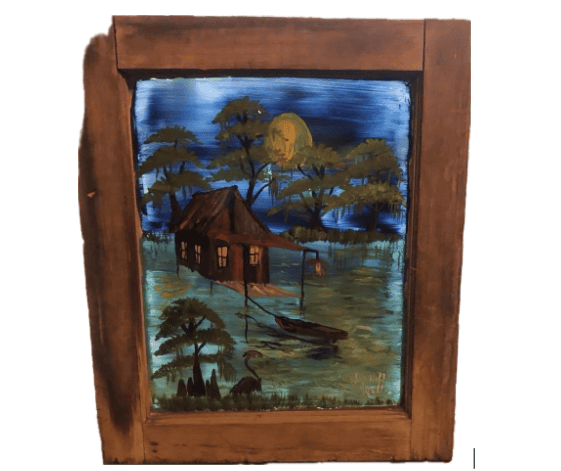
These artistic choices reflect a broader message Holland shares through his work: differences can become sources of identity and creativity. His Treehouse series draws from childhood memories of his parents creating a special place for him after he experienced feelings of isolation because of his disability. The paintings feature treehouses surrounded by words such as “Love,” “Hope,” and “Faith,” representing the encouragement and acceptance he received from his family.
Those themes extend beyond the canvas. Holland and Maria created a self-published children’s book, The Zydeco Krewe, to introduce young readers to the idea that people have different abilities and strengths. Through Louisiana-inspired characters with various disabilities, the story presents inclusion through cooperation and understanding.
Holland’s experiences have also shaped his views on how society engages with disability. He recalls moments when people questioned his ability to work, parent, or participate fully in everyday life because of assumptions connected to his condition. His own relationship with Maria has reinforced his belief that disability cannot be defined through a single experience. “People see the wheelchair, the speech, or the way someone moves, and sometimes they stop there,” Holland says. “They need to see the person, the dreams, the talents, and the life behind it.”
Across society, disability is increasingly being discussed through the lens of lived experience rather than broad stereotypes. As more people share their perspectives, public conversations are becoming richer, more reflective, and more attentive to the diversity that exists within disability itself.
That broader understanding has the potential to influence how communities, institutions, and individuals engage with one another. Recognizing people as individuals first creates space for greater connection, participation, and appreciation of the many ways people contribute to the world around them.
