
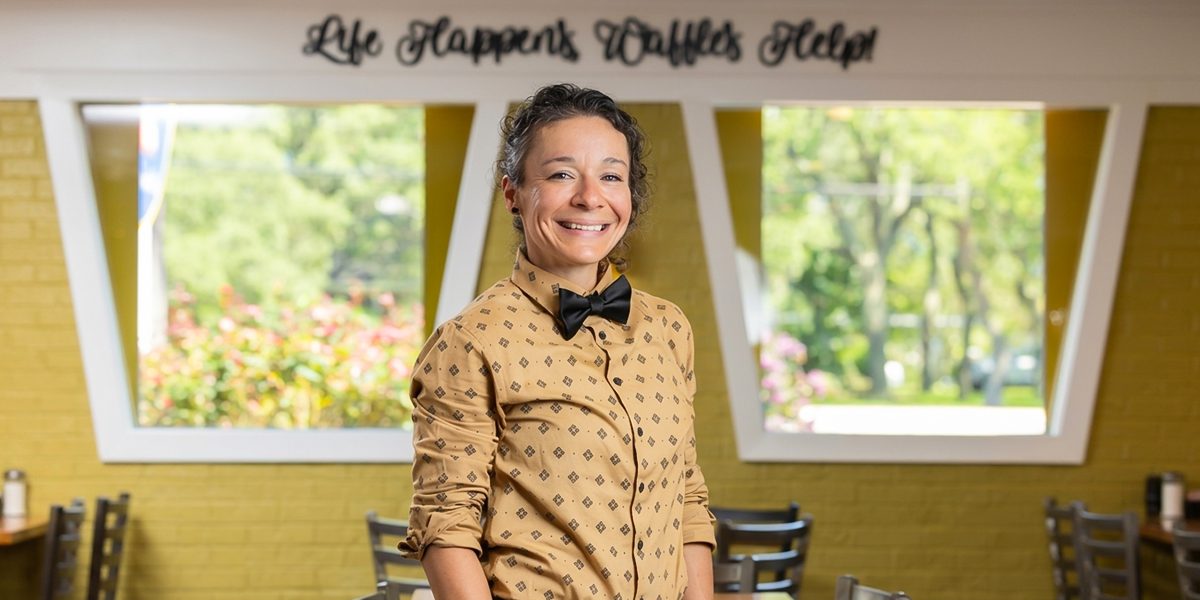
Chef Jamie Daskalis is a chef, restaurateur, author, and community advocate. Her journey began in New York’s restaurant scene, where she grew up watching her father, Johnny Daskalis, build his diner business. Through those early years, she developed a thorough understanding of hard work, discipline, and guest service, qualities that define Johnny D’s Waffles and Benedicts. After graduating from the Culinary Institute of America, she returned to the family business and continued developing her skills in the kitchen. Moving to South Carolina opened a new chapter for her. In Myrtle Beach, she created her own culinary identity through Johnny D’s Waffles and Benedicts.
Today, Johnny D’s has become known for creative breakfast dishes and scratch-made food. Its menu brings classic diner favorites together with dishes such as red velvet waffles, coconut banana French toast, and pork belly Benedicts. Chef Jamie has also created the Making It Delicious product line, written a cookbook, and taken the stage as a speaker. She also works to raise awareness about autism and support local families.
In this interview, Chef Jamie Daskalis discusses family legacy, creativity, leadership, hospitality, community, and her vision for the years ahead.
Jamie, your earliest understanding of restaurants was formed inside your father’s New York diners, long before culinary school or the opening of Johnny D’s in Myrtle Beach. Looking back, when did you first realize that hospitality was no longer simply the family world you had inherited, but a legacy you would become responsible for shaping? How did that realization change your identity as a chef and leader?
Chef Jamie Daskalis: I’m not sure there was one moment when I realized it. For a long time, restaurants were simply the world I grew up in. They were my father’s world first, and I learned by watching him, sometimes by following his example and sometimes by realizing there were things I wanted to do differently.
When my father and I built Johnny D’s together in Myrtle Beach, something began to shift. I wasn’t just working in his restaurants anymore. I was developing my own food, my own leadership style, and my own ideas about what hospitality could be. He gave me the foundation, but he also gave me the space to make my own mark.
I think I fully understood the weight of that after he became sick and passed away. Suddenly, the person I had always called when I didn’t know what to do wasn’t there anymore. I had three restaurants, teams depending on me, a family depending on me, and this thing we had built together that I now had the responsibility of carrying forward.
That changed my understanding of legacy. I don’t believe honoring my father means doing everything exactly the way he would have done it. It means taking everything he taught me, combining it with everything I’ve learned along the way, and continuing to evolve.
As a chef and a leader, I’ve become much more confident in trusting my own instincts. I’m still very much my father’s daughter, and there are pieces of him in the way I operate every day. But Johnny D’s also carries my fingerprints now, and I think he would be proud of that.
A family legacy can serve as both a compass and a constraint. In the major decisions you faced after your father’s passing, what did you deliberately preserve because it carried his spirit, what did you give yourself permission to change, and what has that process taught you about honoring a founder without allowing the brand to become frozen in time?
Chef Jamie Daskalis: There were things I knew immediately I never wanted to change. My father believed deeply in taking care of people. He believed in consistency, hard work, knowing your business inside and out, and never asking someone to do something you weren’t willing to do yourself. Those values are still very much the foundation of Johnny D’s.
But I also had to give myself permission to stop asking, “What would Dad do?” every time I made a decision. That was probably harder than I realized. My father and I were very different people and, even when he was alive, we didn’t always approach things the same way. Over time, I realized that preserving his legacy didn’t mean preserving every decision he would have made.
I’ve allowed the food to evolve. I’ve changed systems, embraced new ideas, become more intentional about our culture and the way we lead our teams, and continued shaping Johnny D’s into the restaurant I believe it needs to be today. Some of those decisions might not have been the ones my father would have made, and I’ve become comfortable with that.
What I’ve learned is that a legacy shouldn’t be a museum. If you protect it so carefully that nothing is ever allowed to change, eventually it stops growing. I can honor my father by protecting the values that mattered to him while still allowing the business to evolve beyond him. To me, that’s actually the greatest respect I can give what he built: not simply preserving it, but making sure it continues to have a future.
Previously, you have highlighted the relationship between creativity and the consistency that makes guests feel at home. What does consistency require behind the scenes, not only in recipes, but also in hiring, training, service recovery, and leadership, and why do you believe that kind of reliability can create a sense of emotional safety for both guests and employees?
Chef Jamie Daskalis: Consistency is probably one of the hardest things to achieve in a restaurant because it touches everything. Of course, recipes have to be written, portions have to be controlled, and food has to leave the kitchen the same way every time. But consistency is just as important in how we hire, train, communicate, solve problems, and lead.
I’m a big believer in structure. Our employees should know what is expected of them, but they should also know what they can expect from us. Training should be consistent. Standards shouldn’t change depending on which manager is working. When something goes wrong, the goal should always be to solve the problem rather than assign blame. And as leaders, we have to hold ourselves to the same standards we expect from everyone else.
Guests feel that consistency too. They come back because they know what their favorite dish is going to taste like, but also because they recognize the faces, understand the rhythm of the restaurant, and know how they’re going to be treated. There’s comfort in familiarity.
I think that’s where emotional safety comes from for both guests and employees: knowing what to expect. Creativity keeps a restaurant interesting, but consistency is what builds trust. And ultimately, trust is what makes people want to come back.
Johnny D’s has been described as combining “the best of the old and the best of the new,” balancing familiar diner traditions with inventive waffles, Benedicts, cocktails, and lunch offerings. As the brand expands, what test must a new idea pass before it deserves a place on the menu or within the guest experience? Can you share an example of a promising concept you chose not to pursue because it did not serve the brand’s deeper promise?
Chef Jamie Daskalis: A new idea has to do more than taste good. It has to make sense for Johnny D’s. I can come up with something creative all day long, but if my kitchen can’t execute it consistently during a busy Sunday morning, if it requires ingredients that don’t make sense operationally, or if a guest looks at it and wonders why it’s on our menu, then it probably doesn’t belong.
I think the best Johnny D’s dishes have a little familiarity and a little surprise. There should be something that makes you curious, but it still has to feel approachable. I never want us chasing trends simply because they’re popular. We can evolve without becoming something we’re not.
There have been plenty of dishes and ideas that were genuinely good but never made it past testing. Sometimes the flavor was there, but the execution was too complicated. Sometimes an idea looked great on paper but didn’t add anything meaningful to the menu. And sometimes I simply realized, “That’s good, but it’s not Johnny D’s.”
As we grow, that filter becomes even more important. Creativity gets an idea onto the table. Consistency, practicality, and whether it genuinely improves the guest experience determine whether it stays there.
As technology, automation, and data become more embedded in restaurant operations, what do you believe the next era of hospitality must protect at all costs? How can independent, family-run brands embrace innovation and improve efficiency without losing the intuition, personal connection, and sense of belonging that make guests feel genuinely cared for?
Chef Jamie Daskalis: I’m not afraid of technology. If something can make us more efficient, give us better information, reduce mistakes, or make our employees’ jobs easier, I think we should be willing to explore it. But the one thing I never want technology to replace is human connection.
Hospitality is noticing things. It’s recognizing the guest who comes in every Sunday, remembering where they like to sit, noticing when someone seems overwhelmed, or realizing a table needs something before they have to ask. A computer can collect an incredible amount of data, but there is still something uniquely human about being able to read a room.
For an independent restaurant, I think the goal should be to use technology behind the scenes so our people can be more present in front of the guest. If automation gives a manager more time to coach their team, or gives a server more time to actually connect with a table, then it’s serving hospitality rather than replacing it.
As the industry changes, I think we have to protect that at all costs. People have endless choices for where and how they get food. What they can’t order from an app is the feeling of walking into a place where someone genuinely knows them, sees them, and is happy they came back. That sense of belonging is still the heart of hospitality, and I don’t think that should ever change.
And lastly, you are increasingly taking your experience beyond the restaurant through Making It Delicious products, speaking engagements, and media appearances. What unifying mission connects these different ventures, and five or ten years from now, how will you determine whether you have meaningfully expanded the Johnny D’s legacy?
Chef Jamie Daskalis: For me, the common thread has always been connection. Johnny D’s creates that through food and hospitality. Making It Delicious gives people a way to bring some of that experience into their own kitchens. Speaking and media give me an opportunity to share what I’ve learned, the successes, the mistakes, and the lessons that came from both.
Five or ten years from now, I don’t think I’ll measure the Johnny D’s legacy simply by how many restaurants we have or how many products we sell. Growth matters, but bigger isn’t necessarily the same as better.
I’ll measure it by whether we continued to make an impact. Did we create opportunities for the people who worked with us? Did our guests continue to feel connected to the brand? Did Making It Delicious inspire someone to feel more confident in their own kitchen? Did something I shared help another business owner, chef, parent, or young person believe they could figure out their own path?
My father built restaurants, but what he really left behind was an impact on people. I think my responsibility is to take that foundation and expand what it can mean. If, years from now, Johnny D’s represents more than a place people went for breakfast, if it represents creativity, hospitality, resilience, and a genuine connection to people, then I’ll feel like I carried the legacy forward in a meaningful way.
Conclusion
Chef Jamie Daskalis’ story shows how a family business can grow while staying connected to its roots. Her father’s lessons, including hard work, discipline, consistency, and care for guests, continue to play a huge role in how Johnny D’s operates. At the same time, Chef Jamie has developed a clear identity of her own. Her approach to food is creative and personal. She looks at color, texture, sweetness, acidity, spice, and crunch when developing new dishes. That curiosity has helped Johnny D’s create a menu that gives guests familiar favorites alongside unexpected combinations. Looking ahead, Chef Jamie Daskalis sees growth as making an impact; she is giving the Johnny D’s story a future shaped by family, food, and purpose.