
“One size fits none,” 45-year-old Omer Golan said while getting a tattoo with his wife there for support. “You choose your pain and suffering. You choose your own adventure.”
Golan wasn’t just getting a tattoo. He was healing.
A New Approach to Trauma Recovery
American Friends of NATAL teamed up with Healing Ink to raise awareness for mental health services while using tattooing to help people process their trauma at an event in the Lower East Side last month.
American Friends of NATAL helps fundraise for the Israeli mental health organization, NATAL, which has six units offering services like 24/7 helplines for Israeli civilians and servicemembers.
“What’s special about NATAL is that there’s no one size fits all,” Friends of NATAL CEO Maayan Aviv said. “It’s about finding the right way to heal for each individual.”
NATAL started in 1998 to help Yom Kippur War veterans and receives some funding from the Ministry of Defense.
NATAL’s clinical unit sees about 3,200 patients weekly, up from a weekly average of 350 patients before Oct. 7th, in part driving NATAL to expand during the last few years.
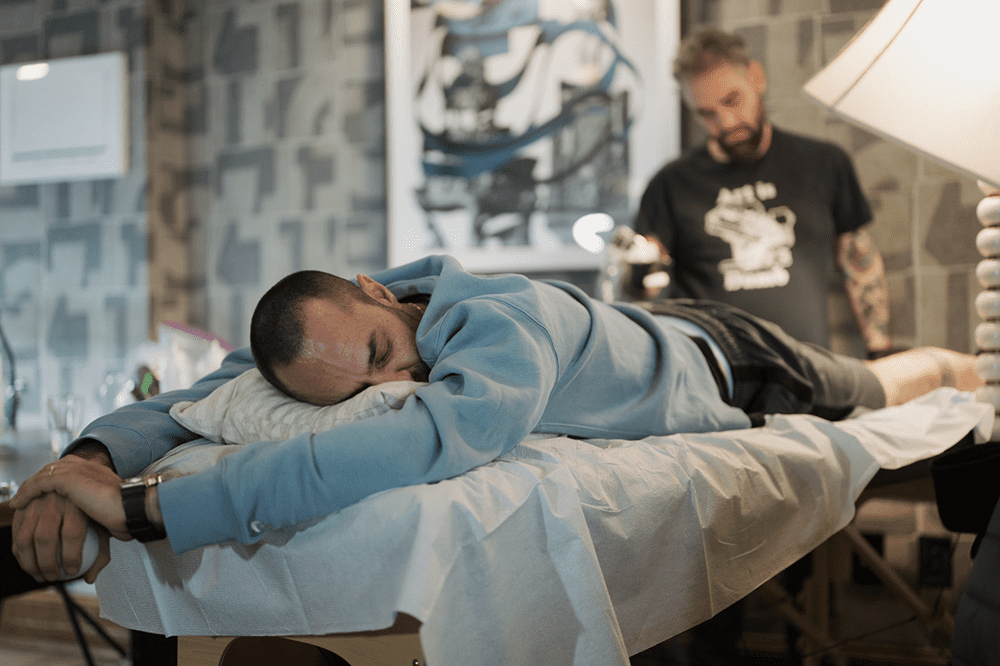
Photo: Ben Kelmer
The Art of Processing Pain
American Friends of NATAL tends to create events like galas that take a few months of planning, which makes this tattooing event unusual. Aviv said that an out-of-the-box event planned in seven days like this one may not be for everyone but helps show how this type of an event can make a difference in a survivor’s life.
The unorthodox idea came from a partnership American Friends of NATAL has with Healing Ink, which works within an organization called Art Over Hate Collective and uses tattooing to help people process trauma. Aviv met Art Over Hate Collective CEO Craig Dershowitz two years ago and appreciated his vision while having an instant connection with him.
“Healing Ink covers the scars of survivors of mass violence, first responders, and the families of victims,” Dershowitz said.
Healing Ink started as a program with Artists 4 Israel in 2016, “and then it grew so quickly that it kind of took on a life of its own,” Dershowitz said.
While taking a wound and turning it into artwork and a benchmark of progress plays a big role in the work Healing Ink does, the therapy goes deeper than the art.
“The tattoo and open scar is the key of what unlocks the healing, but part of the other elements of that is the community and the ecosystem around which that tattoo was built,” Dershowitz said. “Tattoo artists, like barbers and bartenders, could probably teach mental health professionals a thing or two.”
The artists come to Healing Ink after working with Healing Ink previously or they come through word of mouth. “So everyone is, at this point, a friend of a friend, or vetted through the community we’ve built,” Dershowitz explained.
Artists meet with a mental health team, have conversations, informal training, and discussions about what they’ll experience. The team wants to make sure the artists come prepared to handle hearing tough stories. Healing Ink and its mental health team learn from the artists as well about the artists’ work and perspectives.
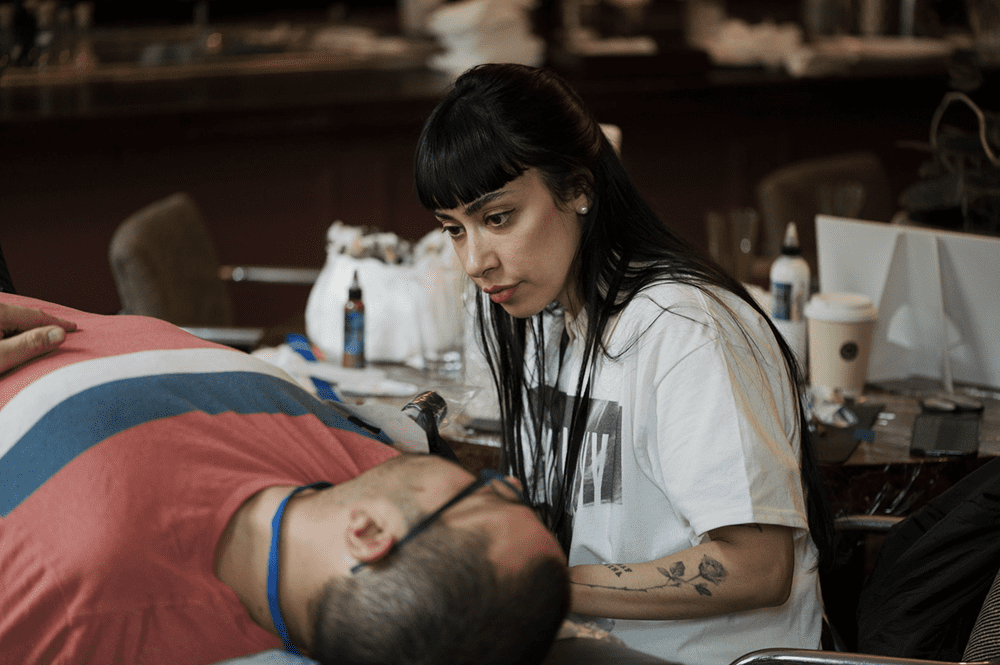
Photo: Ben Kelmer
The Energy of Custom Healing
Tattoo artist Shug Shyam comes from a spiritual yoga community in Maine where helping others forms a way of life. He works with people he meets through his community who experienced a lot of problems, and he works with some clients with military service and major trauma.
While his experience helps, this event and every tattooing session differ.
“You’re working with people, and there’s definitely an energy exchange that’s happening,” Shug said, adding that he needs to discuss the intention and meaning of the work with the person, making it a “living, breathing vessel.”
Shug only does custom work so he can tap into the personalization that the client needs, and he does his artwork while providing support.
“Usually in a situation when you’re dealing with heavy things, you have to be there for the person, not with your own idea, not your own head, inserting and pushing,” Shug said.
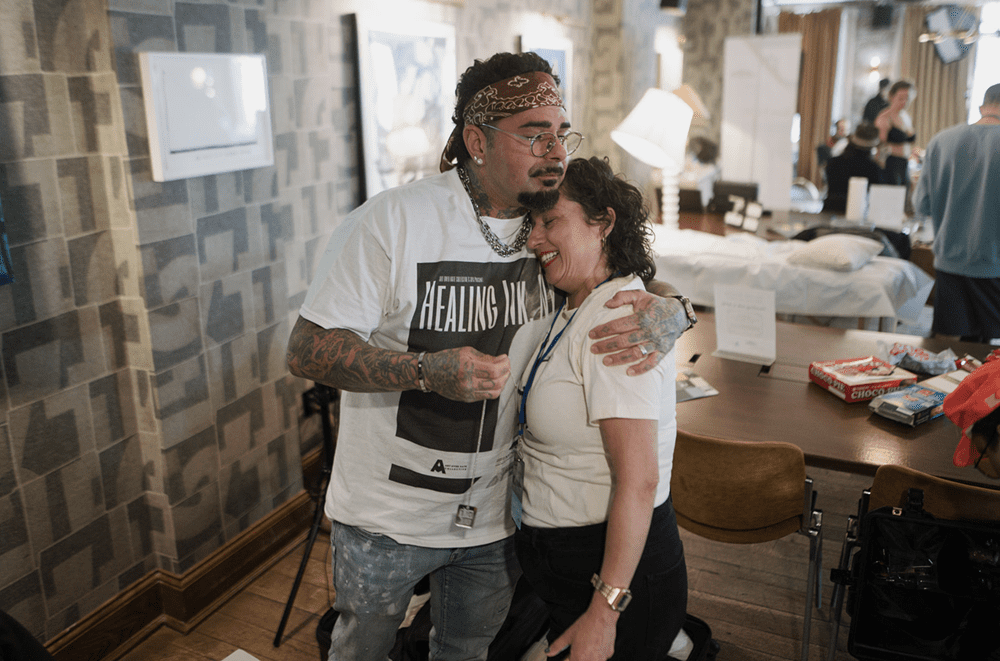
Photo: Ben Kelmer
Turning Survival into Inspiration
Back on the other side of the room, Golan nearly died as a 20-year-old army servicemember after someone hugged him from behind and set off 50 pounds of explosives with shrapnel at a bus stop in Israel.
“I died for a little bit, and then someone found me and saved my life,” Golan said. He woke up about a month later in the hospital where he spent around a year recovering from issues like 80 percent of his body being burned and shrapnel pieces like a Luger 9mm World War I-era bullet that sticks out of his arm.
Golan thinks inspiration can be part of the healing process. “Inspiration leads to hope,” Golan said, adding that other people in similar situations may think “maybe I could survive something like that as well.”
